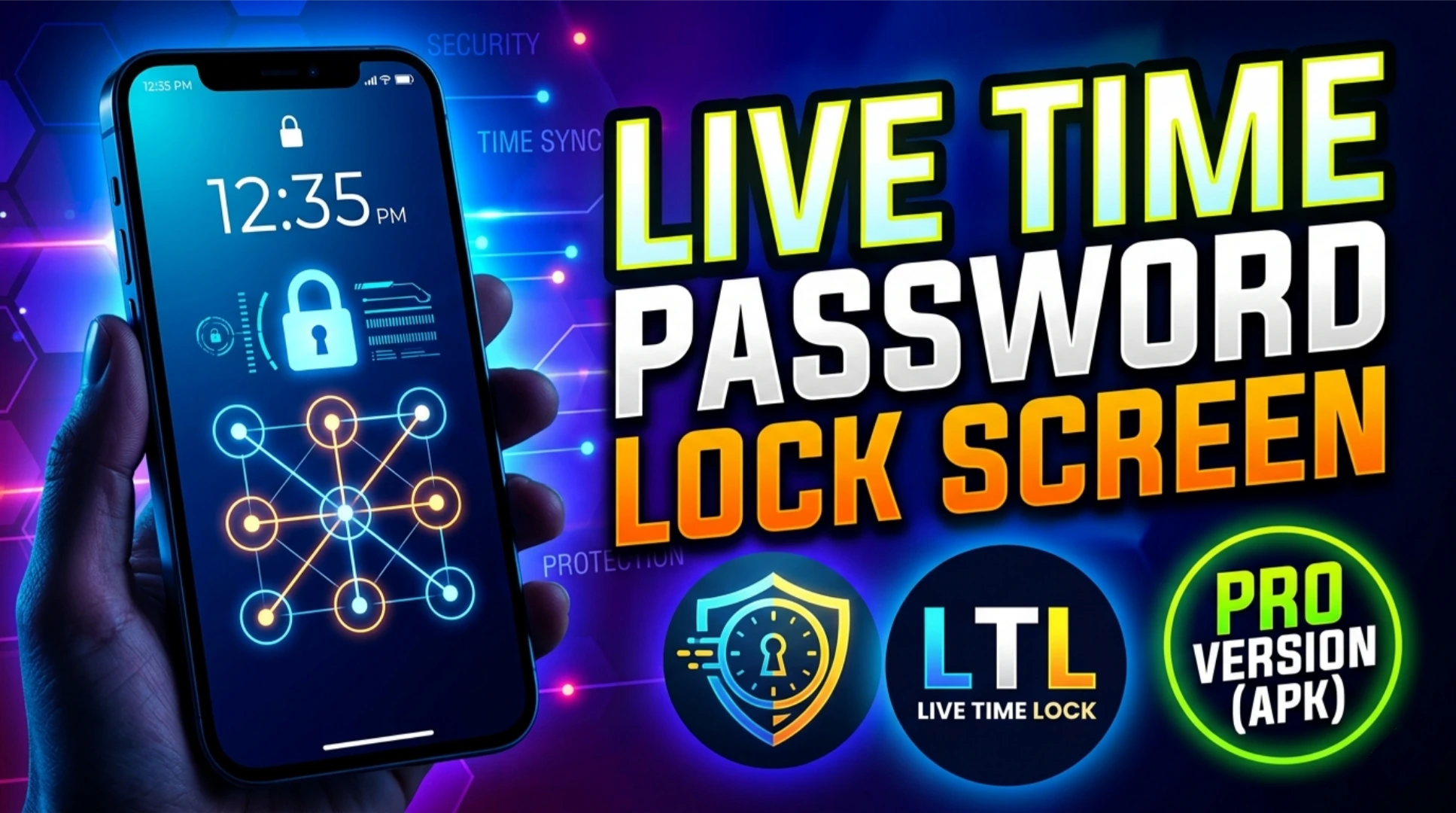
Live Time Password Lock Screen APK
The Live Time Password Lock Screen APK a revolutionary approach to mobile authentication that combines real-time temporal dynamics with robust encryption. Unlike static passwords that remain valid until changed, a live time password (LTP) changes continuously based on the current time, offering a moving target to potential attackers.
This article explores everything you need to know about this innovative security solution, including its features, benefits, installation process, and why it is gaining traction among privacy-conscious Android users in 2026.
What Is a Live Time Password Lock Screen APK?
A Live Time Password Lock Screen APK is an Android application package that replaces your device’s default lock screen with a dynamic authentication system. Instead of setting a fixed numeric or alphanumeric password, the app generates a password that is a function of the current time (e.g., hour, minute, second) combined with a secret key known only to the user. For example, if the time is 14:35, the password might be 1435 or a hash like #1435*. This password changes every minute or every few seconds, rendering any stolen or observed password useless after a short interval.
These APKs are particularly popular among journalists, activists, corporate executives, and anyone handling confidential information. The Live Time Password Lock Screen APK is not a typical app found on the Google Play Store due to its sensitive nature; instead, it is often distributed as a direct APK download from trusted security forums or developer websites.
How Does Live Time Password Technology Work?
To understand the power of the Live Time Password Lock Screen APK, one must grasp the underlying algorithm. Most implementations rely on Time-based One-Time Password (TOTP) principles, similar to those used by Google Authenticator or hardware tokens. However, instead of a separate authenticator app, the lock screen itself acts as both the generator and the verifier.
Here is a step-by-step breakdown:
-
Secret Key Setup: When you first install the Live Time Password Lock Screen APK, you define a master secret key (a numeric or alphanumeric string). This key is stored locally in an encrypted form using Android’s Keystore system.
-
Time Synchronization: The app reads the device’s system time (or an atomic time server via internet) to ensure accuracy. A mismatch of more than a few seconds can lead to authentication failures, so most apps include a time drift correction feature.
-
Password Generation: At any given moment, the app computes a password by applying a cryptographic hash (like SHA-1 or HMAC) to the current timestamp (usually truncated to 30-second or 60-second intervals). The result is converted into a numeric or alphanumeric string, often 4–8 digits long.
-
Authentication: When you wake your phone, the lock screen displays a prompt. You must enter the password that is valid for that exact moment. Because the Live Time Password Lock Screen APK knows the same secret key and time, it can verify your input locally without an internet connection.
-
Fallback Mechanisms: To prevent lockouts, reputable APKs include emergency backup codes or a secondary authentication method (e.g., pattern or fingerprint) that bypasses the live time requirement.
Key Features
Not all APKs are created equal. When selecting a Live Time Password Lock Screen APK for your Android device, prioritize the following features:
-
Offline Functionality: The app should work without an internet connection after initial setup. Relying on external servers defeats the purpose of local security.
-
Anti-Screenshot Protection: Many high-quality APKs prevent screenshots of the lock screen or the password entry field, thwarting shoulder-surfing attacks.
-
Brute-Force Delay: After a few incorrect attempts, the app should impose an exponential delay (e.g., 5 seconds, 30 seconds, 5 minutes) to discourage automated guessing.
-
Customizable Time Intervals: Advanced versions allow you to set password validity to 30 seconds, 1 minute, or even 5 minutes based on your threat model.
-
Stealth Mode: Some Live Time Password Lock Screen APK implementations hide the password hints or the current time display, forcing the attacker to know both the secret key and the exact time.
-
Backup and Sync: Secure cloud backup of your secret key (encrypted with a master password) ensures you won’t lose access after a factory reset.
Step-by-Step Installation Guide for Live Time Password Lock Screen APK
Because these APKs are not available on official app stores, you must enable installation from unknown sources. Follow this guide carefully:
-
Enable Unknown Sources: Go to Settings > Security > Install unknown apps (or Special app access) and allow your browser or file manager to install APKs.
-
Download from Trusted Source: Search for a reputable Live Time Password Lock Screen APK on platforms like GitHub, F-Droid, or established security blogs. Avoid random file-sharing sites. Look for open-source projects where the code has been audited.
-
Verify the File: Before installing, check the APK’s SHA-256 hash against the developer’s published value to ensure it hasn’t been tampered with.
-
Install and Grant Permissions: Tap the downloaded APK, confirm installation, and grant necessary permissions such as “Draw over other apps” and “Device administrator” (required to replace the lock screen).
-
Set as Default Lock Screen: After installation, open the app and follow the setup wizard. You will be prompted to activate the Live Time Password Lock Screen APK as your device administrator. Then, disable the default lock screen (PIN/pattern) so the live time method takes over.
-
Configure Your Secret Key: Choose a strong master secret key—preferably a random mix of numbers and letters. Store this key in a secure password manager or write it down and keep it in a safe place. Without this key, you will be permanently locked out.
-
Test the System: Lock your device and try unlocking it with the correct time-based password. Also, intentionally enter a wrong password to verify the delay mechanism works.
Advantages Over Traditional Lock Screens
Why would anyone switch from a fingerprint or face unlock to a Live Time Password Lock Screen APK? Here are compelling reasons:
-
Resilience Against Eavesdropping: If someone watches you enter your password, that password expires within a minute. In contrast, a static PIN can be reused indefinitely.
-
No Biometric Vulnerabilities: Fingerprints can be cloned from surfaces, and face unlock can be fooled by photos or videos. Live time passwords rely solely on a secret key that never leaves your device.
-
Protection Against Coercion: If forced to unlock your phone under duress, you can enter a wrong password intentionally. The attacker might assume you made a mistake, but they cannot extract a reusable password because the next minute’s password is different.
-
No Cloud Dependency: Unlike password managers or cloud-based 2FA, the Live Time Password Lock Screen APK works entirely offline, eliminating the risk of server-side breaches.
Potential Drawbacks and How to Mitigate Them
No security solution is perfect. The Live Time Password Lock Screen APK has limitations that users must address:
-
Time Synchronization Issues: If your phone’s clock drifts significantly (e.g., after removing the battery or traveling across time zones), the generated password may not match. Mitigation: Enable automatic network time and consider using an app that syncs with NTP servers periodically.
-
Inconvenience: Calculating the current password manually every time you unlock can be tedious. Mitigation: Choose longer validity intervals (e.g., 5 minutes) or pair the live time password with a fingerprint as a secondary factor.
-
No Official Support: Since these APKs are not vetted by Google, bugs or vulnerabilities could exist. Mitigation: Stick to open-source projects with active communities and regular updates. Review the code if you have the technical skill.
-
Lockout Risk: Forgetting your secret key or a major time desync can permanently lock you out. Mitigation: Always configure emergency bypass options (e.g., a separate static password or email-based recovery).
Security Best Practices for 2026
As mobile threats evolve, so should your habits. If you decide to use a Live Time Password Lock Screen APK, follow these best practices:
-
Regularly Update the APK: Check the developer’s repository for patches, especially after Android OS updates.
-
Use a Hardware Security Key Companion: Some advanced APKs allow you to pair with a YubiKey or similar device to generate the live time password, further reducing software risks.
-
Disable USB Debugging: When the lock screen is active, USB debugging can sometimes allow bypasses. Keep it off in developer options.
-
Encrypt Your Device: Combine the Live Time Password Lock Screen APK with full-disk encryption (enabled by default on modern Android devices) for defense in depth.
-
Beware of Evil Maid Attacks: An attacker with physical access could replace your APK with a malicious version. Use Android’s verified boot and avoid leaving your device unattended.
Is a Live Time Password Lock Screen APK Right for You?
This technology is not for casual users who prioritize convenience over security. However, if you handle sensitive corporate data, engage in political activism, or simply value privacy in an age of mass surveillance, the Live Time Password Lock Screen APK offers a formidable layer of protection. It transforms your lock screen from a static gate into a dynamic, time-aware sentinel.
Before downloading, assess your threat model. Are you worried about opportunistic thieves or targeted adversaries? For most people, a strong static PIN and biometrics suffice. But for high-risk individuals, the live time password is one of the few consumer-accessible technologies that can defeat advanced persistent threats.
Conclusion
The Live Time Password Lock Screen APK represents a paradigm shift in mobile security, merging cryptographic principles with real-time data to create a lock screen that is truly dynamic. While it requires more effort than traditional methods, the added protection against replay attacks, shoulder surfing, and coercion is invaluable for those who need it.
By carefully selecting a trusted APK, following the installation guide, and adhering to security best practices, you can significantly harden your Android device against unauthorized access in 2026 and beyond.